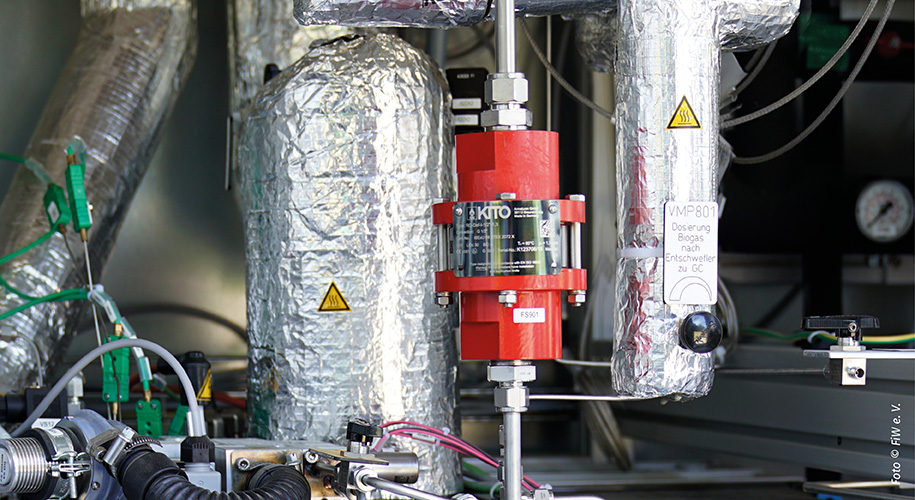
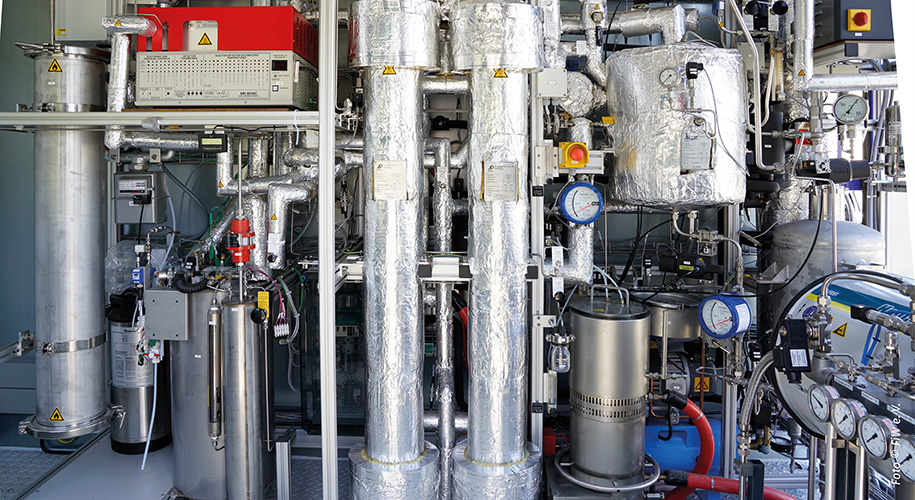
The ongoing defossilization of energy-intensive sectors is driving rapid demand for renewable substitutes for basic chemicals and fuels. Biomass utilization plays a key role in the decentralized supply of the biogenic resources required. Against this backdrop, FiW investigates CO₂-selective membrane processes and thermochemical conversion pathways to transform biogas as a biogenic carbon source into renewable fuels and feedstocks.
Since 2012, FiW has advanced the direct utilization of biogas via various synthesis processes across several consecutive research projects. The current project, B2M Raman, funded by the BMWE, scales an efficient biogas-to-methanol process from laboratory to pilot scale. Methanol is a versatile key molecule for defossilization serving as an alternative fuel, energy storage medium and chemical feedstock.
Between 2020 and 2023, extensive process optimizations enabled cost-efficient methanol synthesis from biogas and sewage gas. B2M Raman advances this further, targeting process optimization under both static and dynamic operating conditions, and integrating Raman spectroscopy for real-time, active process control. Elevated process pressure increases conversion rates and pushes the concept toward an economically viable, decentralized plant solution.
In collaboration with OWI Science for Fuels gGmbH, the autothermal reforming stage, developed in preceding projects, is further optimized. A recycle stream of unreacted synthesis gas is extracted downstream of the reactor and reintroduced into the process. This recycling significantly reduces carbon losses and maximizes the carbon efficiency of the reaction loop.
Beyond operational optimization, B2M Raman evaluates a novel methanol catalyst designed to increase CO₂ conversion to methanol. Hydrogen integration for syngas recycling creates synergies with oxygen utilization in autothermal biogas reforming, enabling efficient electrolyzer coupling. This positions the process as a power-to-X sink, supporting broad sector coupling options.
The Institute for Environment & Energy, Technology & Analytics e.V. (IUTA) is working within the project on real-time process gas analysis using Raman probes. By evaluating the composition of the educt and product gases, dynamic process control in response to fluctuating electricity and hydrogen prices is enabled. The project aims for economically viable production conditions through these transient operating states.
The overall process has reached a readiness level that enables transfer to industrial production scale. It offers a pathway to partially defossilize methanol-dependent value chains through decentralized bio-methanol supply. For the biogas sector, it provides a complementary revenue stream. While many biogas plant operators currently focus on power generation, the synthesis of renewable platform chemicals represents a viable alternative to complex feed-in tariff schemes under the German Renewable Energy Act (EEG). The process is applicable to industrial operators with on-site biogas plants, standalone biogas facilities, and operators in agriculture and water management alike.
Contact
Dr.-Ing. Carl Fritsch
+49 241 80 2 39 55
/ E-Mail
