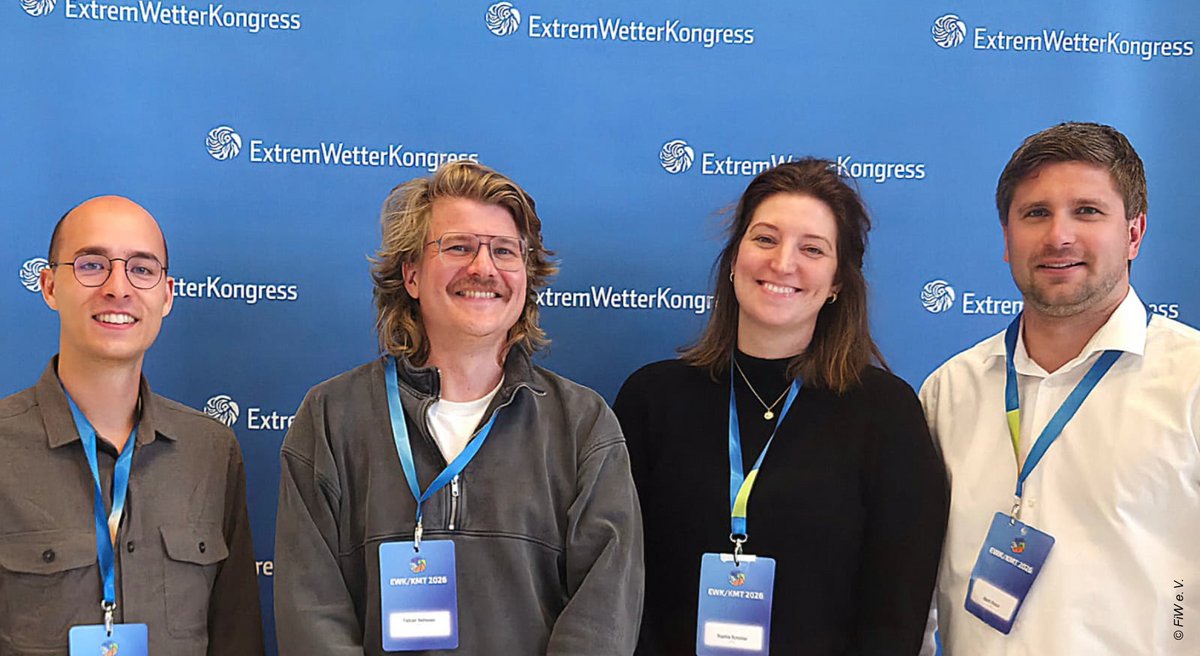
From 23 to 25 September 2026, the Extreme Weather Congress took place together with the Climate Management Conference at HafenCityUniversity Hamburg. Representatives from science, politics, public administration, business and the media discussed current research findings, strategies for adapting to climate change and the communication of climate risks. The team of the R2K-Klim+ project, funded by the German Federal Ministry of Research, Technology and Space (BMFTR), contributed two sessions: a workshop together with the City of Duisburg and a talk on prioritising adaptation measures.
The congress took place after a summer whose consequences can be quantified. According to the Robert Koch Institute, the heat claimed the lives of more than 16,000 people in Germany. In Hamburg, temperatures rose above 39 degrees Celsius; cooling systems, the A7 motorway and a runway at the airport suffered under the heat. At the congress, the German Institute for Economic Research (DIW) presented a projection: heat, flash floods and storms could cost Germany at least 280 billion euros by 2050. If climate action does not advance quickly, damages could rise to as much as 900 billion euros. Tobias Fuchs of the German Weather Service (DWD) warned at the opening: "Coming summers will be even hotter." For Conference President Frank Böttcher, the summer has made it clear that "climate change and its consequences are really here now." He therefore calls for faster adaptation. Contributions to the programme came from, among others, Luisa Neubauer, Sven Plöger and Prof. Dr. Harald Lesch. The congress was also covered by tagesschau.de, NDR Info and others.
Climate adaptation affects urban planning, crisis preparedness, social infrastructure and local businesses at the same time. Even so, many organisations treat it as an additional cross-cutting task alongside day-to-day business. In municipalities, responsibilities and interfaces are often complex, and many of the people who prepare decisions or implement measures lack detailed knowledge of climate risks. The result: climate adaptation reaches the agenda late, in isolated cases, or only after an event.
In the session, Sophia Schüller and Fabian Nellesen of the City of Duisburg transferred a concept from marketing to planning processes: the customer journey, that is, the sequence of touchpoints through which people come into contact with a topic. It ranges from first awareness ("I've heard of that") through the decision ("I'm going to do something now") to the role of advocate for the topic. Together with participants from municipalities, science, media and practice, they developed a "climate adaptation journey" as a map. Guiding questions included, for example: Which touchpoints do employees and decision-makers currently have with climate adaptation, for instance through events, planning routines or funding applications? The result was a transferable logic of touchpoints and roles. Municipalities can use it as a starting point for their own participation and training strategies. Dr.-Ing. Mark Braun and Gregorio Cevoli supported the session.
On Friday, Dr.-Ing. Mark Braun presented the decision support system KLAUS (KLimaAnpassung Urbaner Systeme, "Climate Adaptation of Urban Systems") under the title "Using limited resources effectively: decision support for prioritising measures". KLAUS is a web-based, map-based system that bundles decision-relevant information for the City of Duisburg. It assesses how strongly flooding and heat affect individual areas and presents the results through comparable indicators. (Link)
Using screenshots and real use cases, the talk showed how KLAUS supports municipal questions in Duisburg, for example:
- selecting locations for new drinking water fountains, taking climate impacts and vulnerable groups into account
- identifying deficit areas as a technical basis for funding measures
- using heavy rainfall simulations in urban drainage planning
Taking part in Hamburg allowed FiW to discuss both approaches with experts from municipal practice and to take feedback back for further development.
Since 2020, the research project R2K-Klim+ has been funded by the BMFTR under the funding guideline "RegIKlim - Regionale Informationen zum Klimahandeln" (Regional Information for Climate Action).
Contact
Sophia Schüller, M.Sc.
+49 241 80 2 68 17
/ E-Mail