
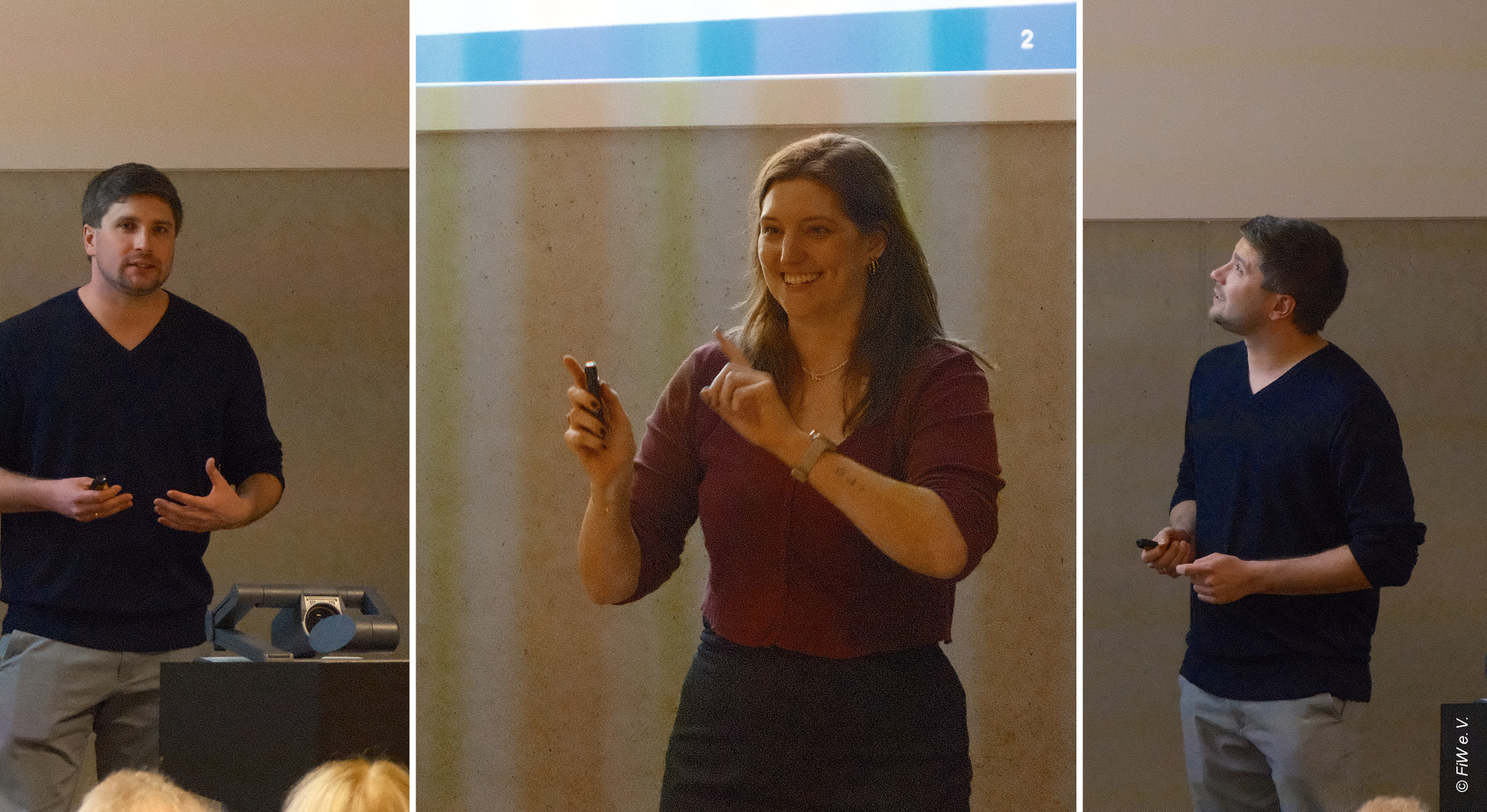
Around 8,000 visitors attended the RWTH Science Night on 14 November to explore research from Aachen. The FiW contributed an exhibition stand and a late-evening talk – both of which attracted steady interest until the end of the event.
At the stand, FiW used a 3D model to illustrate how heavy rainfall, heat or flooding affect cities and neighbourhoods. With the help of augmented reality, various climate impacts and the effects of possible measures could be visualised on a tablet in an easily understandable way. Many visitors discussed approaches such as reducing sealed surfaces, greening roofs and façades, or retaining rainwater, and asked about practical options for municipalities and private households.
The talk “Adapting Instead of Waiting – Understanding and Acting on Urban Climate Impacts” by Sophia Schüller and Mark Braun was well attended despite the late hour. Using Aachen as an example, the team explained how local heavy rainfall events develop and why behavioural preparedness matters — for instance, how to handle heat appropriately or take simple precautionary steps at home.
Feedback showed that climate adaptation still requires explanation for many people, even though extreme weather events have become more frequent and visible in recent years. Events such as Science Night offer an opportunity to share knowledge in an accessible way and reduce barriers to engagement.
We would like to thank the Science Night team and RWTH Aachen for the excellent organisation and look forward to taking part again next year.
Contact
Sophia Schüller, M.Sc.
+49 241 80 2 68 17
/ E-Mail
